Finding commonality at Beijing's West Qing Tombs
by Guy Rubin
What is it that you, me and the last Qing dynasty Emperor, Puyi, could all have in common? Absolute power at the age of two? Two wives for our sixteenth birthday? A flawed come-back in our thirties? Or maybe it's that now we can all be buried together.
A commercial cemetery is the latest addition to the impressive Western Qing tombs. Having arranged for the relocation of Emperor Puyi's ashes to this newly opened cemetery, Hong Kong entrepreneur Zhang Shiyi is now selling burial lots in this fengshui-enhanced vicinity.
And not a bad idea it is too. For a visit to this beatific valley, adorned with more than seventy Imperial tombs, affords a rare pleasure. These Qing dynasty tombs echo and embolden their surrounding landscape. Austere courtyards mimic the graceful sweep of a wide, valley floor. While their raised "Soul Towers" lead your eyes upwards to the rugged mountains behind, their intricate, marble bridges invite you to glance down at their picturesque, moss-covered moats. The buildings' deference to their setting however, does not impugn their Imperial hauteur – for though they harmoniously blend in with their surroundings, their sheer size is spell-binding.
Unlike the Ming dynasty Emperors whose tombs are collected in one lush valley, the burial grounds of the Qing dynasty have been split between two main locations – the Eastern and Western Tombs. But why did the Qing dynasty require two separate burial sites?
 The reason dates back to a Dostoevskian tale of love and hate; of physical crime and spiritual punishment. When the Emperor Kangxi (r 1662-1722) bequeathed his empire to a younger son, Yongzheng (r. 1723-1735) usurped his father's throne and, to stave off their potential challenge, executed all his brothers as well as his father's ministers. Subsequently ridden with guilt, this ambitious ruler couldn't bear the thought of being buried next to his father. By selecting a burial site diametrically opposite the established Imperial Tombs, on the western as opposed to the eastern side of Beijing, Yongzheng instituted the Western Qing Tombs.
After comparing both sites, you will be in little doubt that Emperor Yongzheng was as frenziedly competitive in death as he had been in life. His tomb, the first at the Western Qing tombs, makes his father's at the Eastern look penny-pinching by comparison. For though Emperor Kangxi's tomb is expansive, his son's is built on an altogether more massive scale, reminiscent of the imposing majesty of the Forbidden City's southern courtyards. Its aesthetic merit lies as much in its appealing form as it does in embodying the unquestioning authority of its all-powerful occupant. Ironic then that so great an achievement should be inspired by so petty an ambition.
This narrow-mindedness is counterbalanced by the largesse of the second Emperor to be buried at the Western Qing Tombs, Emperor Jiaqing (r.1796-1820). Unwilling to surpass and thereby call into question the glory of his ancestor, Emperor Jiaqing thought it politic only to equal him. Except that he took his idea to an unnecessary extreme.
His tomb, Changling, relinquishing all individuality, is to every degree an exact copy of that of Emperor Yongzheng. So much so that when we arrived there, our navigator bet another friend 100 dollars that we'd taken the wrong turn and had, in error, returned to Yongzheng's tomb. It was an easy mistake to make. For the design of the bridges, the positioning of the well-preserved outhouses, even the brown mule and the souvenir stalls in front of the ticket office looked precisely the same – as if an age-old hoax were being intentionally perpetuated to the present day. Our bewilderment only intensified as, strolling though the tomb, we confirmed its similarity to the tiniest detail.
Jiaqing's Empress, fortunately, had no such pretensions to modesty. Her immaculate tomb next door, at Changxiling (Western Changling), sports the only Echo Wall I have ever had the joyful opportunity of testing. Indeed, as promised by Chinese guides at Beijing's ever crowded Temple of Heaven, if a message is whispered on one side of the circular wall, this will be perfectly audible to someone standing on the other. And by altering your position within the centre of the circular wall, you can adjust the number of echoes returned to you. Great fun when it works.
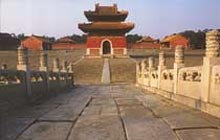 Having spent two days exploring its curiosities, we were thoroughly charmed by this 800 km² Qing dynasty burial site. So pleasant is its setting and so magisterial its tombs that we could deeply sympathize with Emperor Puyi's last words, whispered to his wife, Li Shuxian, as he lay dying of cancer in 1967. "Please, please bury my ashes at the side of my adoptive father," he pleaded. It is wonderful that, after so sad a life, his last wish came true.
As it could for you on down payment of $40,000.
Getting there
The most direct route to the Western Qing Tombs is to drive south west along the "Jingshi" highway, which links Beijing to Shijiazhuang. After about 80km, on arrival at Gaobeidian, head west for Yixian. The tombs are 16km west of Yixian on highway 112. Expect the journey from central Beijing to take over 3 hours.
original publication May 2000, Chinanow.com
Two hours from Beijing, Baiyangdian in summer metamorphoses from a drab swamp into a colorful checkerboard of lotus patches and fish nurseries
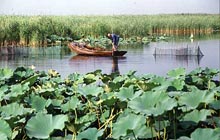
The sun may have taken the weather forecasters by surprise, but not the lotus flowers. Attuned to the barest climatic fluctuation, they are already on the threshold of their summer bloom.
A gathering tide of flowering lotuses is now sweeping across China, transforming seemingly destitute marshlands into scenic tableaux of white, pink and yellow. Fortunately, Beijing residents do not need to journey far to treat themselves to Nature's floral coronation. For only 150 kilometres south west of the capital, bending under a gentle breeze, sway thousands of blossoming water lilies and lotuses.
Baiyangdian is a wetland area on the central plain of Hebei province. In the summer, as its name implies, it metamorphoses from a drab swamp into a "white ocean of lakes". This 360 square kilometre marsh, criss-crossed by thousands of rivers and ditches, comes alive in a colorful checkerboard of water-based nurseries. Only the local fishermen know their way through the maze of tall reeds to the oases of lotuses and water lilies concealed within.
 Gliding in a wooden punt through this sea of flowers, the sun's breath on your cheek, a hand trailing languidly in the cool, mirror-like water, your thoughts may wander from workaday to spiritual concerns. Such a reaction would be in keeping with the ancient symbolism of the lotus; it was Buddha, in similarly idyllic circumstances, who compared its growth with a person's path to Enlightenment–from lowly, sightless incipience to elevated, all-seeing maturity.
This is not to suggest that Baiyangdian affords nothing more than exquisite panoramas. Apart from the cultivation of shrimp, crabs, ducks and fish, enclosed within picturesque bamboo and net boundaries, you might want to observe the cormorant fishing here. Although the best time to do this is at dawn, when the fishermen hunt in packs, late in the afternoon you can still come upon isolated groups. On spotting a shoal of fish, the boatmen beat the water with their oars. This throws the shoal into agitated confusion and prompts the cormorant birds to give chase. Thanks to their heavy bones and lungs' small gas cells, these birds are able to dive swiftly underwater after the scattering fish. Having trapped their prey inside capacious gullets, they return them to their owners in exchange for well-deserved rewards.
While the menfolk earn their living on the water, the village women are busily engaged in a land-based cottage industry. In the village of Xilidi, women of all ages sit in the shade of a weeping willow weaving reed mats. Once the long reeds have dried in the sun, girls split them length-wise with a sharp blade. The resulting strands are passed to their mothers and elder sisters, some of whom can weave as many as two large mats a day. From the flower-lined lake shore, these mats make their way to the granaries of the north east, whence we came.
It was indeed in Xilidi that our group was privileged to receive a hearty welcome. We foreigners were overwhelmed by scores of friendly villagers eagerly offering their local delicacy — shrimp biscuits. Although relishing our first mouthful of these deep-fried, shrimp, our hosts' zealous hospitality soon all but destroyed our appetite for them. Only on condition that we accepted three rods of sugar cane and several plastic bags of lotus seeds did the villagers eventually accede to our departure. As they stood on the lake bank, waving us off, I felt quite embarrassed by their unreserved generosity.
In few places is the paradox of progress better presented than at Baiyangdian. For just as Buddhists today marvel at its wealth of lotuses so, in the past, have Mammonists salivated at its abundance of subterranean crude oil. Unlike monks however, bankers tend to discount the environment. So intense was their quarry for black gold here, that this wetland's pristine beauty was nearly forsaken for it. Many fishermen only maintained their livelihood and cormorants by relocating to China's southern provinces.
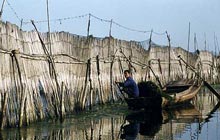 Twenty years later, the oil-men are but a sorry memory. The fishermen have returned and the lake restored to its pristine splendor. Nonetheless, the Mammonist streak lurks in mitigated form. It is heard in the tinny jingle of a fair ground installed on one central island or spied in the crenellated outline of a nearby mini-theme park.
Families may well appreciate such distractions. For those that don't, Baiyangdian is still large enough to harbor many tranquil alternatives. Enjoy at your leisure the innate wealth of its welcoming inhabitants and inspiring beauty.
Take the two hour train ride from Beijing to Baoding. A bus to Anxin leaves from Baoding train station. However, since this is infrequent you might negotiate with a taxi driver to complete the 40 km journey. At Anxin's port, there is no shortage of fishermen eager to hire themselves out. We paid ¥300 for a day's boating, but this could probably be reduced.
On the lake, travelers should ask their boatman to take them to the Dongfang hotel, run by Mr Xia Jiabin (Tel – 0312 5239105). This is on its own island within the precincts of the village of Quantou. Mr Xia charges ¥60 for a fairly basic double room with a fan but no bathroom. Since he's only got five such rooms, it's probably best to phone ahead. Although facilities are wanting, the hotel's location is unsurpassable. Its drive is a narrow canal, cut straight as a Roman road through endless stretches of reeds. Alternatively, you could stay at Anxin at the Anxin Hotel.
July 20-August 2, 2000 CITY WEEKEND
by Peter Neville-Hadley, Editor-in-Chief

Send those friends and relations off on an unusual summer tour
Despite repeated predictions that in a very short period China will overtake France as the number one travel market in the world, the opening up of China's travel industry to the creation of Sino-foreign joint-ventures last year has been met with little enthusiasm, not least because it has yet to be deregulated sufficiently to guarantee a reasonable return.
Hopes that the improvement in service brought about by more domestic competition would now be accelerated have been dashed. But more choice is nevertheless on the way for foreign visitors to China, represented by a growth in small foreign companies operated not by those who see China as just another market, but those who use their own love of the country to create imaginative and reliably comfortable tours.
If you want to relieve yourself of the need to entertain visiting firends and relations for the whole of their sojourns this summer, a recently formed American company can take them off your hands. It offers five-star, tailor-made special interest and small group tours, which are constantly monitored to make sure the fifth star never takes a day off.
Pleasing the customer
Imperial Tours is the creation of a Briton and a Korean-American who met while students at Beijing Language and Culture University. Guy Rubin gave up a career in the arcane world of strategy consulting to come to China to write a novel, and ended up starting the US-registered Imperial Tours with Nancy Kim.
The company has been operational for about 18 months. Bespoke tours are created to suit interests in everything form botany to Chinese furniture, but even the regular 15 day small goup tours which tackle some of China's greatest hits – Beijing, Xi'an, Guilin, Hangzhou and Shanghai – include unusual elements such as picnics at the less-visited of the Ming Tombs or dinner al fresco on the shores of Beijing's Qian Hai.
"We've personally eaten our way through most of the menus of the restaurants, and we personally interview all the guides. We also escort all major tours ourselves," says Rubin. From Xi'an to Suzhou this avoids problems of the "Oh, we're really full – you're in the old wing this time" variety.
"The biggest problem is service – the idea of pleasing the customer. Here, the main idea is often getting away with the least expense that seems to matter," says Kim. Having made exact selections for hotels, restaurants and other services, the company books what it can itself, and the remainder as the law requires, through a Chinese agent. But the personal touches – an album of photos from the trip, a hotpot to act as a memento of an open-air banquet – and the attention to details all too often absent from tour arrangments in China, make all the difference.
July 22-July 5, 2000 CITY WEEKEND
by Polly Evans, Editor
Top tips for holiday planners
 For those traveling to China who are fed up with staying in hotels which don't quite meet the mark, a new luxury tour company, Imperial Tours , has researched all the major hotels in China's most-visited locations, with the aim of offering guests the ultimate in luxury and elegance. These are the spots it recommends: Starting in Beijing, the newest and most stylish hotel in town is the Kerry Centre Hotel (Behind the China World Trade Centre at 1 Guanghua Lu, 86-10-6561-8833). By the end of this year, the Kerry Centre will also house Beijing's best and largest gym. In Shanghai, there's no competition for the Grand Hyatt (Jinmao Tower, 2 Century Boulevard, Pudong, 86-21-5047-1234). Taking up the 54th to 88th floors, this is one of hte world's most spectacular hotels: Each room-including the bathroom-has floor-to-ceiling glass windows which give sensational views across Shanghai. If you're heading off to see the terracotta warriors in Xi'an, the best night's rest can be had from the Shangri-La Golden Flower (8 Changle West Rd., 86-29-323-2981), whose rooms are larger and more tastefully decorated than those at either the Hyatt or the Sheraton. The hotel is situated on the west side of the city, and so is convenient for the terracotta army. Meanwhile in Suzhou, the Sheraton (388 Xinshi Lu, 86-512-510-3388) opened its doors earlier this year. It is elegantly designed with traditional Chinese architecture, but the best time to see it is after dark, when you can appreciate the full effect of its illuminated facades and reflective pools. The Shangri-La takes the prize again in Hangzhou (78 Beishan Lu, 86-571-797-7951) with its fantastic location on the northern shore of hte West Lake and set deep wihin its own extensive gardens. Renovations are due to be completed in December, after which this will be the place to stay in Hangzhou. For more information from Imperial Tours, email, web_inquiry@imperialtours.net.
HK Magazine Friday NOV 5 1999